A restless night last night. Kept turning things over in my mind. My comprehensive exams are beginning to press. When I wasn't thinking about them, I was thinking about stuff at church. And when that wasn't the case, I would turn over Christmas plans. Finally, around 4 in the morning, I took out my book and began reading, until I drifted back to sleep again. It's left me feeling vaguely unsettled today.
It is always a balance thing, especially with so many pieces to look after--the academic, church, and home. And each of those made up of numerous things themselves. When things get off balance, everything wobbles. Like an old vinyl record that's gotten warped. I watch it go 'round in a gentle wave, distorting sound. It's a feeling of unease.
Sunday was a beautiful day. The choir had the lead in the service. And their music was a real gift. The words of the music came to life this year, as I looked on what remained of our creche. I became aware that I am yearning for joy now. The hard realities represented by our creche have taken root in me. And I find my soul wants to fly.
Advent has been a long, fierce lament this year. And I feel the urging of the lament to turn to praise, as it so often does. On Sunday, as the choir sang, that juxtaposition of lament and praise was made vibrant. No gentle transition here. Heartache. Gladness.
Last night as D and I talked over dinner, I finally saw something about the creche for the first time. D was telling me how he felt as though we had created something true, not something 'edgy,' as we've fondly started referring to the creche. "What I see in that creche is all of the offense of the original birth. And that's what I feel like the important thing is. It's not whether it will turn off visitors from coming back; it's not about pushing the boundaries; it's not about forgetting tradition. It's a radical representation of a most radical event."
During Sunday school, as we reflected together on our experiences of the creche, someone asked D: "Do you see hope when you look at that scene, then?" And he said he didn't yet. And I would have answered the same way. No hope yet, no.
But last night at dinner, we saw it. We're not waiting for hope to present itself to that scene. The hope is already present. The hope is precisely that this is the very place God is incarnate. I've been so close to seeing it before, but never quite did. God is in this place. God is in this place.
. . . Tonight we will get to celebrate Christmas with S before she leaves tomorrow. We'll enjoy a good dinner and exchange gifts. Then D will be off for his first-ever Roller Hockey game! This is suddenly a new passion for him that we're all quite excited about. He played lots of hockey as a kid. But it's been years. Last week, as he prepared to visit the rink for the first time, we joked about what he should say to folks when he got there: "I used to play hockey a lot as a kid. But I got away from it as a young adult. And it's been years, now, since I've played. Then I had a child, and I wanted him to know about hockey. So I thought I should find a place and get involved again . . ." And the angels were rejoicing in heaven.
Showing posts with label Advent 2005. Show all posts
Showing posts with label Advent 2005. Show all posts
Tuesday, December 20, 2005
Saturday, December 17, 2005
All Blue in the Face - On the Liturgical Color of Advent
Thanks to Jan, over at a Church for Starving Artists, who asks: Is Blue the New Purple? for the season of Advent. You put a bee in my bonnet to see what I could find out about the shift in color for Advent. (As a PhD student in Liturgical Studies, these kinds of questions get my juices flowing!)
Jan mentions that she likes the color purple because it highlights Advent as a mini-Lent. This gets at the crux of the shift in color association. The shift from purple to blue occured largely in order to distinguish the themes of Advent from the themes of Lent, to make the seasons more distinct from one another. (In addition to being a brilliant marketing ploy, as Jan muses.) :)
But the very theme of penitance has been a sticky one in recent liturgical reformation movements. For instance, in the Eucharistic service for the United Methodist Church, the prayer of confession is moved away from the Table part of the service and up to the front of the worship service--in order dissociate the feeling that we have to "get ourselves right with God" before we can approach God. For those of us shaped even a little by the Lutheran tradition, this is a grace-filled move.
In addition, even the theme of penitance during Lent has been tempered in recent years by liturgical theologians. Lent as a season for the preparation of baptism (and re-affirmation of baptism) has been emphasized even more than penitance.
Blue for Advent, therefore, also serves to downplay the theme of penitence. It is intended to lift up the eschatological aspect of Advent (our longing for the reign of God to be fulfilled). The emphasis on eschatology is also meant to serve as a corrective, I believe, to a more historicist approach to the season which is often dominant in our churches. The historicist approach tends to make Advent a season of Make-Believe--when we make believe that the baby Jesus hasn't been born yet, a wink-wink, nudge-nudge approach to experiencing the story of our faith.
The apocolyptic texts of the lectionary enforce the eschatological emphasis, making it near impossible to cozy up to the notion of pretending we're waiting for the baby Jesus--rather, we find ourselves trembling with the mountains at the anticipation of the Day of the Lord.
This year, I've been able to re-connect a sense of penitence to that anticipation. Though it has not been a personal-sin penitence, but a corporate, systemic, liberation-theology sense of Sin that has informed my vision this year. I've heard Mark's demand to "Stay awake!" and John's call to repent more in these terms.
The change from purple to blue is a fascinating, contemporary opportunity to observe how liturgical change takes place. Clearly, some liturgical "experts" likely empassioned by the ecumenical and liturgical movements, thought it would be better if we used blue rather than purple for Advent. Little by little, churches on the local level began to pick up on this shift. (Memos were distributed in seminaries, perhaps.) :) Now we're seeing a real mixture of practices on the local level. Ultimately, I believe, this is where liturgical change either takes hold or doesn't. Ultimately, it ain't what the experts say they want, but what the people do.
Jan mentions that she likes the color purple because it highlights Advent as a mini-Lent. This gets at the crux of the shift in color association. The shift from purple to blue occured largely in order to distinguish the themes of Advent from the themes of Lent, to make the seasons more distinct from one another. (In addition to being a brilliant marketing ploy, as Jan muses.) :)
But the very theme of penitance has been a sticky one in recent liturgical reformation movements. For instance, in the Eucharistic service for the United Methodist Church, the prayer of confession is moved away from the Table part of the service and up to the front of the worship service--in order dissociate the feeling that we have to "get ourselves right with God" before we can approach God. For those of us shaped even a little by the Lutheran tradition, this is a grace-filled move.
In addition, even the theme of penitance during Lent has been tempered in recent years by liturgical theologians. Lent as a season for the preparation of baptism (and re-affirmation of baptism) has been emphasized even more than penitance.
Blue for Advent, therefore, also serves to downplay the theme of penitence. It is intended to lift up the eschatological aspect of Advent (our longing for the reign of God to be fulfilled). The emphasis on eschatology is also meant to serve as a corrective, I believe, to a more historicist approach to the season which is often dominant in our churches. The historicist approach tends to make Advent a season of Make-Believe--when we make believe that the baby Jesus hasn't been born yet, a wink-wink, nudge-nudge approach to experiencing the story of our faith.
The apocolyptic texts of the lectionary enforce the eschatological emphasis, making it near impossible to cozy up to the notion of pretending we're waiting for the baby Jesus--rather, we find ourselves trembling with the mountains at the anticipation of the Day of the Lord.
This year, I've been able to re-connect a sense of penitence to that anticipation. Though it has not been a personal-sin penitence, but a corporate, systemic, liberation-theology sense of Sin that has informed my vision this year. I've heard Mark's demand to "Stay awake!" and John's call to repent more in these terms.
The change from purple to blue is a fascinating, contemporary opportunity to observe how liturgical change takes place. Clearly, some liturgical "experts" likely empassioned by the ecumenical and liturgical movements, thought it would be better if we used blue rather than purple for Advent. Little by little, churches on the local level began to pick up on this shift. (Memos were distributed in seminaries, perhaps.) :) Now we're seeing a real mixture of practices on the local level. Ultimately, I believe, this is where liturgical change either takes hold or doesn't. Ultimately, it ain't what the experts say they want, but what the people do.
Wednesday, December 14, 2005
Advent Closure
A good conversation today around what's going on with our creche. After a night to sleep on it and some prayerful letting go, I see a way that we can bring closure to the creche as we have it now in order to make the space more familiar to folks in time for Christmas Eve.
There was one comment from a church member which has helped me to re-cast the vision for myself. It came from a person who is deeply aware of the pain, poverty, and brokenness of the world. She takes this in to her soul throughout her week and comes to worship, in some sense, to seek healing for the pain that is in the world. To be confronted with the creche scene as we'd created it, made the space feel no longer safe to her.
We also wondered together if some of the resistance was because we had relied too much on folks' capacity to engage with symbols. We created an intentionally ambiguous scene: is it a homeless encampment? Katrina? a 'generic' scene of devastation? For me, the creche gathered into itself all the pain of this past year and set it in the context of the Incarnation--in such a way that it reminded me that nothing happens outside of God, no devastation is beyond God. But for some others, perhaps the scene was inaccessible without offering hints for interpreting it. We offered some, certainly. But we could have done a better job with that.
In his sermon on Sunday, G quoted from O Little Town of Bethlehem: "the hopes and fears of all the years are met in thee tonight." It is a beautiful phrase that captures my experience of the creche.
J made an excellent point. She said that those of us who are behind the creation of the creche have been living with it every day. This is true! I've carried that creche inside me all Advent, trying to think of ways to speak hope into the space, to translate it in worship, to craft worship services with integrity around such a gritty scene. But J rightly pointed out that probably many folks engaged with it for an hour once a week, and if they didn't resonate with it initially, it's possible they simply have turned themselves off to it altogether.
We plan now to ritualize a de-construction of the creche, not in a way that deligitmizes the work, however. On Sunday morning we will remove three sections during the service--the blue tarps, the spraypainted signs, and the shopping cart. This will cue people in to the fact that they can expect a transformation in the space in time for Christmas. (One person has promised to go elsewhere that night if she walks in and sees the creche still there.)
One thing I felt strongly about was that we not tidy everything up, as if the scenes of devastation get resolved neatly once we bring God into it. I felt it should be visible need. But not tidy resolution. It just doesn't work that way.
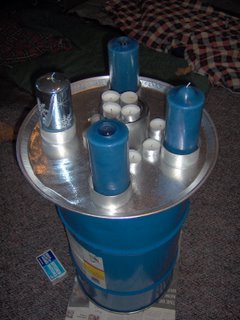
So for Christmas Eve, we will have only the Advent Wreath (the oil barrel) still remaining from the scene. This symbol, I believe, is still strong enough to carry us through. But it will not overwhelm. (The cat has just settled himself across my lap and forearms as I type this!)
This is my feeling about it right now: we have made the long, difficult journey through Advent with this gritty scene of devastation residing at our center. When we celebrate the Incarnation on Christmas Eve (and Christmas morning of course), we will have a present reminder of that journey. But we will be released from the agony of having to take it into ourselves. We will, I hope, be freed to joy.
There was one comment from a church member which has helped me to re-cast the vision for myself. It came from a person who is deeply aware of the pain, poverty, and brokenness of the world. She takes this in to her soul throughout her week and comes to worship, in some sense, to seek healing for the pain that is in the world. To be confronted with the creche scene as we'd created it, made the space feel no longer safe to her.
We also wondered together if some of the resistance was because we had relied too much on folks' capacity to engage with symbols. We created an intentionally ambiguous scene: is it a homeless encampment? Katrina? a 'generic' scene of devastation? For me, the creche gathered into itself all the pain of this past year and set it in the context of the Incarnation--in such a way that it reminded me that nothing happens outside of God, no devastation is beyond God. But for some others, perhaps the scene was inaccessible without offering hints for interpreting it. We offered some, certainly. But we could have done a better job with that.
In his sermon on Sunday, G quoted from O Little Town of Bethlehem: "the hopes and fears of all the years are met in thee tonight." It is a beautiful phrase that captures my experience of the creche.
J made an excellent point. She said that those of us who are behind the creation of the creche have been living with it every day. This is true! I've carried that creche inside me all Advent, trying to think of ways to speak hope into the space, to translate it in worship, to craft worship services with integrity around such a gritty scene. But J rightly pointed out that probably many folks engaged with it for an hour once a week, and if they didn't resonate with it initially, it's possible they simply have turned themselves off to it altogether.
We plan now to ritualize a de-construction of the creche, not in a way that deligitmizes the work, however. On Sunday morning we will remove three sections during the service--the blue tarps, the spraypainted signs, and the shopping cart. This will cue people in to the fact that they can expect a transformation in the space in time for Christmas. (One person has promised to go elsewhere that night if she walks in and sees the creche still there.)
One thing I felt strongly about was that we not tidy everything up, as if the scenes of devastation get resolved neatly once we bring God into it. I felt it should be visible need. But not tidy resolution. It just doesn't work that way.
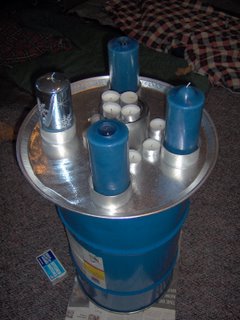
So for Christmas Eve, we will have only the Advent Wreath (the oil barrel) still remaining from the scene. This symbol, I believe, is still strong enough to carry us through. But it will not overwhelm. (The cat has just settled himself across my lap and forearms as I type this!)
This is my feeling about it right now: we have made the long, difficult journey through Advent with this gritty scene of devastation residing at our center. When we celebrate the Incarnation on Christmas Eve (and Christmas morning of course), we will have a present reminder of that journey. But we will be released from the agony of having to take it into ourselves. We will, I hope, be freed to joy.
Tuesday, December 13, 2005
Creche Fallout
 It's happened. Finally. I've been expecting it all along, but began to think once we were through the Third Sunday of Advent that we were in the clear. But I think the days of our contemporary creche scene are numbered now. It seems that while it has been meaningful to some, it has been too raw for others. And this has caused some folks to feel alienated from worship as we've moved through Advent.
The question is now before us: How to proceed in such a way that is 1) respectful and pastoral to those who feel alienated from the project while 2) not doing an injustice to the integrity of the idea, for it does have integrity. (For my original reflections on our creche this year, see this post.)
The only thing I feel certain of is that our next step must be a prayerful one. I don't want to respond from a shallow place inasmuch as this project is important to me as a liturgical theologian. At the same time, I do not want to smooth edges that are rough, that remain rough whether we face them head on or not. By this I mean, the world is broken. Even if we do clean up the sanctuary, the world remains broken.
The idea G and I were working with last week was to create stations for the Christmas Eve service. Each station, located somewhere in the creche, would have a tray (aluminum tray, say, from an empty frozen lasagna pan) full of sand. Each person would be given a long, thin taper (3/4" x 8") which would be lit from the Christ candle then taken prayerfully to one of the stations and placed there. A way of bringing light, warmth, to the darkness. "Jesus Christ is the Light of the World, the Light no darkness can overcome." After this, each person would be given one of those more stubby candles and return to their seat for some Christmas singing. The space was going to be transformed at least to that extent.
Now I have the sense that this will not be enough. And I find myself wondering, how long does the grit have to remain in the oyster before it stops being an irritation and begins to turn into a pearl?
Does transforming the space into something more palatable tame the revolutionary Christ in our midst? Or is it an act of pastoral care?
Tuesday, December 06, 2005



Saturday, December 03, 2005
Advent Fears & Some Firsts
I just got off the phone with someone I'll be co-leading Sunday school with tomorrow morning. B is a chaplain at a psychiatric facility--a sensitive, searching, deep man with a heart for brokenness. The topic for Sunday school is supposed to be "Holiday Blues" intended to address the depression that settles in for so many people at this time of year.
Together B and I have decided to expand the subject a bit, though I believe still addressing it in a very significant way. We are hoping to use the space in the sanctuary to help lead people through their experience of it. We've decided that I will begin the session speaking to the liturgical meanings of Advent as a season that, rooted in the darkening of the days, speaks to our terrors of a world dying. It is a season that invites us into those fears--precisely not a season that asks us to deny them in some manufactured sense of holiday joy.
Then B will lead us through a theory developed by a feminist psychotherapist around honoring our "dark" feelings. The stages as he went through them with me are beautifully intertwined with the movements of the Advent season.
After providing these containers, we will move as a class over to the worship space and allow people to walk through it, come up close to the creche, notice what is there, sit with it. After about ten minutes, we plan to go back to the class and lead folks through a discussion of their experience of it.
I feel positive about the plan. And I am glad to provide a structured way for folks to interact with the creche in an intentional manner.
In other news, I worked on the chair a bit last night. Managed to get the biggest splotches of paint off the seat with the boiled linseed oil. It looked fabulous at first. But now that the oil has dried, I can still see remnants of some of the paint. The site I saw recommends making a paste out of the linseed oil and rottenstone (what a name!) to get out the remnants. So, looks like I need to track down some rottenstone now. :)
I was freaked out last night about all the warnings of rags soaked in linseed oil spontaneously combusting! "No one knows the time or place!" The label warns, in effect. It tells you that even if you plan to set the rag aside for a moment, you need to immerse the rag in water! I have the rags I used (papertowels, really) in a closed container filled with water, as is recommended. But I haven't seen any advice for disposal of this container. Is it considered hazardous waste?
E and D are out playing hockey, E's latest passion. In about an hour we're heading to a local rink to take E ice skating for the first time. Gee, it'll be my first time skating in, hmmm, 16 years? I'm excited!
Oh, and we hung some Christmas lights on the bush outside our front window. Can't wait til nightfall now! It's the first time we've ever hung outside lights.
Guess that's it for me. Happy weekend.
Together B and I have decided to expand the subject a bit, though I believe still addressing it in a very significant way. We are hoping to use the space in the sanctuary to help lead people through their experience of it. We've decided that I will begin the session speaking to the liturgical meanings of Advent as a season that, rooted in the darkening of the days, speaks to our terrors of a world dying. It is a season that invites us into those fears--precisely not a season that asks us to deny them in some manufactured sense of holiday joy.
Then B will lead us through a theory developed by a feminist psychotherapist around honoring our "dark" feelings. The stages as he went through them with me are beautifully intertwined with the movements of the Advent season.
After providing these containers, we will move as a class over to the worship space and allow people to walk through it, come up close to the creche, notice what is there, sit with it. After about ten minutes, we plan to go back to the class and lead folks through a discussion of their experience of it.
I feel positive about the plan. And I am glad to provide a structured way for folks to interact with the creche in an intentional manner.
In other news, I worked on the chair a bit last night. Managed to get the biggest splotches of paint off the seat with the boiled linseed oil. It looked fabulous at first. But now that the oil has dried, I can still see remnants of some of the paint. The site I saw recommends

 making a paste out of the linseed oil and rottenstone (what a name!) to get out the remnants. So, looks like I need to track down some rottenstone now. :)
I was freaked out last night about all the warnings of rags soaked in linseed oil spontaneously combusting! "No one knows the time or place!" The label warns, in effect. It tells you that even if you plan to set the rag aside for a moment, you need to immerse the rag in water! I have the rags I used (papertowels, really) in a closed container filled with water, as is recommended. But I haven't seen any advice for disposal of this container. Is it considered hazardous waste?
E and D are out playing hockey, E's latest passion. In about an hour we're heading to a local rink to take E ice skating for the first time. Gee, it'll be my first time skating in, hmmm, 16 years? I'm excited!
Oh, and we hung some Christmas lights on the bush outside our front window. Can't wait til nightfall now! It's the first time we've ever hung outside lights.
Guess that's it for me. Happy weekend.
Wednesday, November 30, 2005
The Smell of a Stable
These quotes from the liberation theologian Gustavo Gutierrez further inform my experience of our Advent creche at church this year.
"The need to keep awake translates into listening to the clamor for liberation, supporting and empowering our peoples' deepest hopes. Waiting for the Lord does not bring us out of history; it involves us with it since we are hoping for the God who has come and is in our midst. Such a hope is ambitious but it is worthwhile."
"Christmas is a celebration of joy and hope. However, we have to admit that it is not always easy to experience this in today's world. Overwhelmed by the ever-increasing poverty of so many men and women, our shouts of joy at the birth of the Lord seem to choke up in our throats. For many people, bewildered by the difficulty of finding a solution to this predicament, discouragement destroys the energy needed to face this situation.
"Yet the presence of the Lord in our history is a permanent call to return to the sources of our faith. Jesus was born in Bethlehem, surrounded by shepherds and animals. His parents had come to a stable because they had not found a place in the inn. There, in marginality, the Son of God entered history, the Word became flesh. . . .
"During this period of Christmas, people often say that Jesus is born in every family and every Christian heart. But these 'births' must not bypass the primary and undeniable reality: Jesus was born of Mary in the midst of a people dominated at the time by the greatest empire of those days. If we forget this, Jesus' coming into the world can become an abstraction. For Christians, Christmas manifests God's irruption into human history--a Christmas of lowliness and of service in the midst of the power of domination and the predominance of the powerful in this world, an irruption with the smell of a stable.
"God is revealed in Jesus Christ, in him 'the grace of God has appeared, bringing salvation to all' (Ti 2:11). We have to learn to believe from the point of departure of our present historical situation: in the midst of the constant detrioration of the conditions of life of a poor and excluded people, the lack of work and opportunities for so many, the lies and manipulations of the powerful to place a smoke screen over their unjust privileges. From the first Christmas on, we cannot separate Christian faith from human history."
Gustavo Gutierrez in "Sharing the Word through the Liturgical Year." (Orbis Books, 1997)
"The need to keep awake translates into listening to the clamor for liberation, supporting and empowering our peoples' deepest hopes. Waiting for the Lord does not bring us out of history; it involves us with it since we are hoping for the God who has come and is in our midst. Such a hope is ambitious but it is worthwhile."
"Christmas is a celebration of joy and hope. However, we have to admit that it is not always easy to experience this in today's world. Overwhelmed by the ever-increasing poverty of so many men and women, our shouts of joy at the birth of the Lord seem to choke up in our throats. For many people, bewildered by the difficulty of finding a solution to this predicament, discouragement destroys the energy needed to face this situation.
"Yet the presence of the Lord in our history is a permanent call to return to the sources of our faith. Jesus was born in Bethlehem, surrounded by shepherds and animals. His parents had come to a stable because they had not found a place in the inn. There, in marginality, the Son of God entered history, the Word became flesh. . . .
"During this period of Christmas, people often say that Jesus is born in every family and every Christian heart. But these 'births' must not bypass the primary and undeniable reality: Jesus was born of Mary in the midst of a people dominated at the time by the greatest empire of those days. If we forget this, Jesus' coming into the world can become an abstraction. For Christians, Christmas manifests God's irruption into human history--a Christmas of lowliness and of service in the midst of the power of domination and the predominance of the powerful in this world, an irruption with the smell of a stable.
"God is revealed in Jesus Christ, in him 'the grace of God has appeared, bringing salvation to all' (Ti 2:11). We have to learn to believe from the point of departure of our present historical situation: in the midst of the constant detrioration of the conditions of life of a poor and excluded people, the lack of work and opportunities for so many, the lies and manipulations of the powerful to place a smoke screen over their unjust privileges. From the first Christmas on, we cannot separate Christian faith from human history."
Gustavo Gutierrez in "Sharing the Word through the Liturgical Year." (Orbis Books, 1997)
Monday, November 28, 2005
Advent 2005
I've been wanting to write about what we're doing at church this year for Advent. I think I'm finally ready to do that now.
Inspired by a worshipping experience one of our newer members had at Christmas time in Minneapolis some years ago, our worship team worked around the question of recontextualizing the manger scene for contemporary circumstances. We wanted to face the question of where would the Christ child be born today. It feels like a particularly pressing question this Advent, as we come off a year in which the world faced a tsunami, devastating hurricanes, and earthquakes. A year in which the U.S. was faced with our own staggering poverty and systemic inequity that results in the abandonment of the poor, the elderly, children, and racial minorities. If the Christ child were to be born today, we concluded, it would be into one of these scenes of need and devastation.
We talked about the way the manger scene has been romanticized and sanitized--it's a cozy barn, with gentle animals and a warm trough that serves appropriately as a tiny cradle. We have lost the edge of the story--that God-Incarnate was born with nothing. God-Incarnate was born to the poor, not in a wealthy palace, not to Herod, not to the powerful.
So Saturday, for the "Hanging of the Greens," we created our creche scene in response to these reflections. The results are quite moving to me--and I'm sorry I don't have pictures yet to post and show you. (Pictures are now added here.)
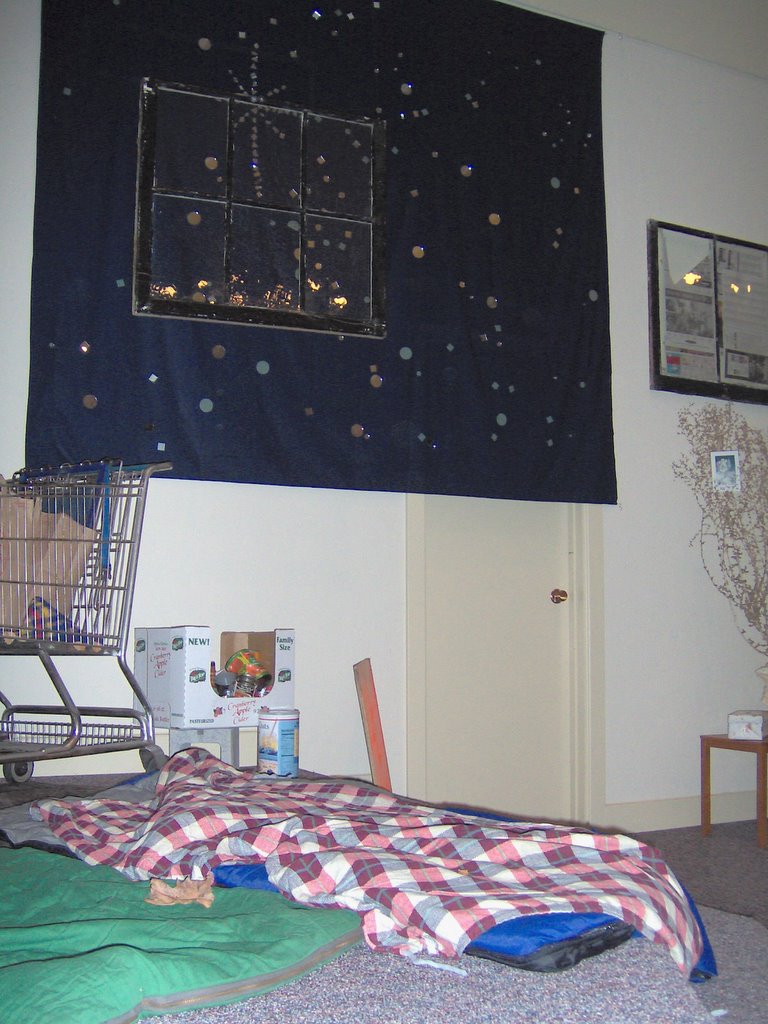
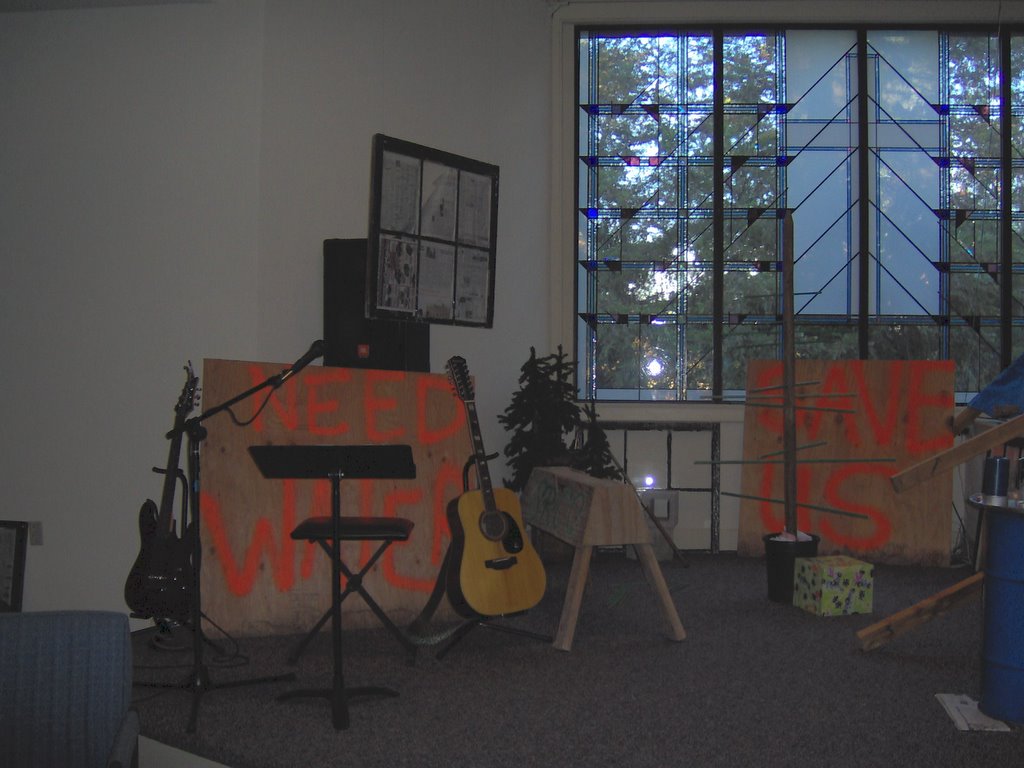
We covered the baptistery at the front of the chancel, then built a roof frame out of two-by-fours that come off the wall above the baptistery at unsettling angles. We covered this frame with blue tarps, to create a make-shift roof. We laid a dirty brown ground cloth over the edge of the baptistry and down along the floor of the chancel in front of it. Then we lay out two sleeping bags. We had some chunks of an old brick wall, with morter still visible, and some cinderblocks and we set these along some back edges. We also brought in an old shopping cart that had been abandoned (well away from any grocery store). We tossed some paperbags full of empty cans and a blanket or two in there and set that in the space as well. Someone found an empty glass milk bottle. They put some ugly plastic flowers in that and added that to the scene. We brought in a bucket of dry, brown leaves and scattered them around the scene and on top of the roof.
Coming out of the chancel and into the sanctuary, we hung some old, salvaged, double-hung windows--extending the scene in the front out to the sanctuary itself. We covered some of those windows with newspapers as is common in empty or abandoned buildings. I used want-ads, real estate announcements (obscene house prices listed), and recent headlines to line the windows.
I also spray painted large pieces of plywood with flourescent orange paint. One with the words "Save Us" another with "Need Water" and a smaller one with the word "Help."
We also hung a dark blue banner with scattered mirrors upon it, some of them (broken fragments) formed into a large star that hangs over the scene. It is, in some sense, the only beautiful element in the scene.
Oh, and the Advent Wreath? This is front and center for the whole scene. We constructed it out of an empty, thirty(?) gallon oil drum set on top of some newspaper. We placed a round, metal tray over it and set out the four Advent candles around that. In the center, we turned over an empty, (label-removed) stew can. We placed tea lights around and on top of the stew can, to create the effect of a fire coming out of the barrel, as you'll often see folks warming themselves around. These tea lights remained lit during the service. On Christmas Eve we'll replace the tea lights on top of the stew can with the tall Christ candle.
The effect, with all of this together, in a worship space that is usually transformed into something serene and inviting at Christmas time, was astounding to me. After it was complete, I wanted to simply sit there and take it in. For me, this is the very reality that the Word-Incarnate has something to say to.
I was very nervous about the reception of this scene by the congregation. I worry that some folks will think we did it only for the shock value. And yet, I don't think that is true at all. Honestly, I couldn't get a read on the congregation. From my perspective, there was a sort of roaring silence about it all. But other folks asked people directly about how they felt about it and they seemed to be taking it in stride. Is this a good thing?
For my own worshipping experience, I decided to pray with my eyes open through the whole service. I felt as though I was being asked, in this Advent season, to keep my eyes open to God's world, the world God loves.
Inspired by a worshipping experience one of our newer members had at Christmas time in Minneapolis some years ago, our worship team worked around the question of recontextualizing the manger scene for contemporary circumstances. We wanted to face the question of where would the Christ child be born today. It feels like a particularly pressing question this Advent, as we come off a year in which the world faced a tsunami, devastating hurricanes, and earthquakes. A year in which the U.S. was faced with our own staggering poverty and systemic inequity that results in the abandonment of the poor, the elderly, children, and racial minorities. If the Christ child were to be born today, we concluded, it would be into one of these scenes of need and devastation.
We talked about the way the manger scene has been romanticized and sanitized--it's a cozy barn, with gentle animals and a warm trough that serves appropriately as a tiny cradle. We have lost the edge of the story--that God-Incarnate was born with nothing. God-Incarnate was born to the poor, not in a wealthy palace, not to Herod, not to the powerful.
So Saturday, for the "Hanging of the Greens," we created our creche scene in response to these reflections. The results are quite moving to me--and I'm sorry I don't have pictures yet to post and show you. (Pictures are now added here.)
We covered the baptistery at the front of the chancel, then built a roof frame out of two-by-fours that come off the wall above the baptistery at unsettling angles. We covered this frame with blue tarps, to create a make-shift roof. We laid a dirty brown ground cloth over the edge of the baptistry and down along the floor of the chancel in front of it. Then we lay out two sleeping bags. We had some chunks of an old brick wall, with morter still visible, and some cinderblocks and we set these along some back edges. We also brought in an old shopping cart that had been abandoned (well away from any grocery store). We tossed some paperbags full of empty cans and a blanket or two in there and set that in the space as well. Someone found an empty glass milk bottle. They put some ugly plastic flowers in that and added that to the scene. We brought in a bucket of dry, brown leaves and scattered them around the scene and on top of the roof.
Coming out of the chancel and into the sanctuary, we hung some old, salvaged, double-hung windows--extending the scene in the front out to the sanctuary itself. We covered some of those windows with newspapers as is common in empty or abandoned buildings. I used want-ads, real estate announcements (obscene house prices listed), and recent headlines to line the windows.
I also spray painted large pieces of plywood with flourescent orange paint. One with the words "Save Us" another with "Need Water" and a smaller one with the word "Help."
We also hung a dark blue banner with scattered mirrors upon it, some of them (broken fragments) formed into a large star that hangs over the scene. It is, in some sense, the only beautiful element in the scene.
Oh, and the Advent Wreath? This is front and center for the whole scene. We constructed it out of an empty, thirty(?) gallon oil drum set on top of some newspaper. We placed a round, metal tray over it and set out the four Advent candles around that. In the center, we turned over an empty, (label-removed) stew can. We placed tea lights around and on top of the stew can, to create the effect of a fire coming out of the barrel, as you'll often see folks warming themselves around. These tea lights remained lit during the service. On Christmas Eve we'll replace the tea lights on top of the stew can with the tall Christ candle.
The effect, with all of this together, in a worship space that is usually transformed into something serene and inviting at Christmas time, was astounding to me. After it was complete, I wanted to simply sit there and take it in. For me, this is the very reality that the Word-Incarnate has something to say to.
I was very nervous about the reception of this scene by the congregation. I worry that some folks will think we did it only for the shock value. And yet, I don't think that is true at all. Honestly, I couldn't get a read on the congregation. From my perspective, there was a sort of roaring silence about it all. But other folks asked people directly about how they felt about it and they seemed to be taking it in stride. Is this a good thing?
For my own worshipping experience, I decided to pray with my eyes open through the whole service. I felt as though I was being asked, in this Advent season, to keep my eyes open to God's world, the world God loves.
Subscribe to:
Posts (Atom)